 In the beginning of 2018, I became a “digital nomad”. I joined a remote work/travel group planning to go to So. America for four months: a month in each of Argentina, Chile, Peru, and Colombia. The first three months went well (as recounted in previous blogs) but the organization running the excursion was showing signs of collapse and I, wisely but reluctantly, decided to skip the last month in Colombia. When I heard that NextTribe was offering a trip there, I saw it as a way to “close the circle” and check it off the list of missed opportunities.
After Brazil, Colombia is the second most biodiverse country on the planet with wide-ranging geography. We were to visit two cities in Colombia’s diverse landscape, Medellín in the Andes mountains and Cartagena, a UNESCO World Heritage Site, on the Caribbean Sea. I was excited! But, when I mentioned this trip to friends and family, many were concerned for my safety.
From narco-terrorism to eco-tourism. True, Colombia has had more than its share of troubles. Narco-terrorism, with its use of violence and intimidation was most prominent during the 1980s and early 1990s when the Medellín Cartel, infamously led by Pablo Escobar, engaged in a violent campaign against the government. What many people might not know is that the country has since experienced a renaissance, a revitalization resulting from social projects and government programs that encourage economic growth, promote tourism, build community, and improve the lives of all Colombians.

It was wonderful. I found both cities to be safe, welcoming, and vibrant hubs of art, culture, and history. And, I got to experience it all firsthand with two fantastic guides, Lee and Tori, who came everywhere with us and seemed to know everything. I enjoyed seven fun-packed, exciting, and educational days…but who’s counting 😉
Starting in Medellín
We kicked off the week with an evening of meet and greet at our hotel, Quinta Ladera, and a lovely dinner at the unusual Alambique restaurant (think antique store/curio shop).


Day one: Art and flowers
Our first outing was focused on art. We started at the Botero plaza in the center of the city where Fernando Botero’s comical and voluminous outdoor sculptures almost beg people to photograph and touch them. Our guides explained Botero’s historical and social importance. Self-titled as “the most Colombian of Columbian artists”, he often used his art to express political criticism. His Wounded Bird and Bird of Peace are a prime example.


Then, to further indulge our senses, we toured the Museo Antioquia, with lots of Botero paintings, and the very ornate Palacio Nacional, which houses a shopping mall in the bottom atrium and art galleries on the floors above.


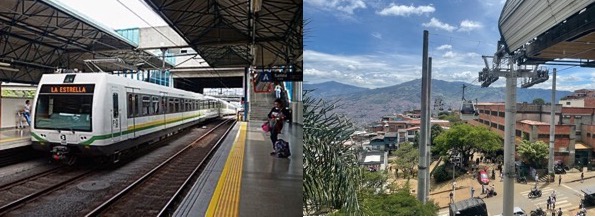
Onward! We followed that by going to the cleanest Metro station I’ve ever seen, riding a train and then a cable car to Parque Arvi to visit a flower farm in Santa Elena. (It’s the Andes Mountains; cable cars are part of the municipal metro system!)
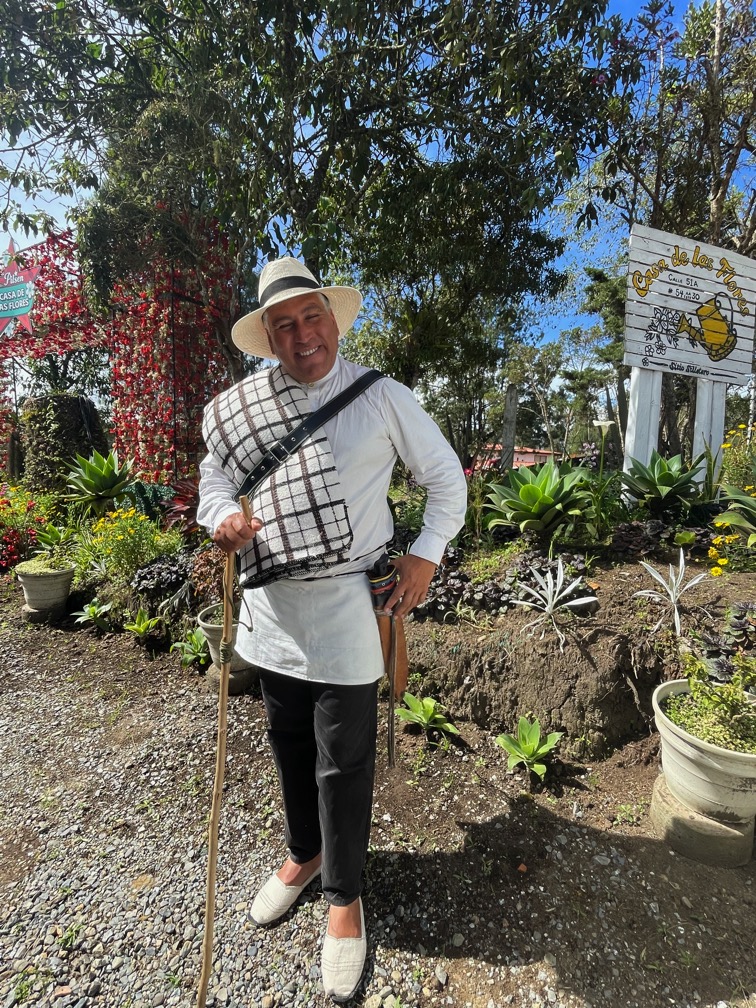
Señor Nacho, the 5th-generation proprietor of Casa de las Flores, explained the competitive annual Feria de las Flores and its Desfile de Silleteros (Silleteros Parade), which is on UNESCO’s list of Intangible Cultural Heritage. He said that it is something like the Rose Bowl parade but, instead of floats, the people carry the floral displays on their backs…and then he demonstrated it for us.
This year the festival was running August 1-10, so the farm was starting to ramp up, hoping to again win a prize. Always smiling and ready to pose for photos, Nacho was so entertaining that he could be a Broadway star!
Day two: Community empowerment
 There is a socioeconomic stratification system in Colombia (known as estratos), which categorizes districts or comunas into six levels based on housing conditions and the surrounding environment. This system determines how much residents pay for essential public utility services but can also be stigmatizing. “Where do you live?” can be a loaded question.
We learned this as we were bussed from our hotel located in affluent El Poblado (level 5-6) up the mountain to visit a women’s social project located in Manrique (level 0-2). Typically, the more impoverished communities are situated further north, away from the city, and this was no exception. Mi Barrio, Mi Sueño is a non-profit, grass-roots organization that empowers women and children to overcome violence, discrimination, economic struggles, and educational barriers.


The founder Andrea Gonzalez Duarte Van Der Leeuw, considered a young social impact hero, mesmerized us with her personal story and invited us to participate in a jewelry-making workshop to create our own beaded bracelets. (Full disclosure: we needed a lot of help.) Afterward, we saw a quick boxing demo and were served a delicious lunch (they cooked for us!) before touring the neighborhood where this group of amazing women provides education, food, and support for local families in need.


We continued to another section of Manrique to tour the Constelaciones, an urban art project sprawling across an entire hillside, created through the Agency for Public-Private Partnerships (APP).
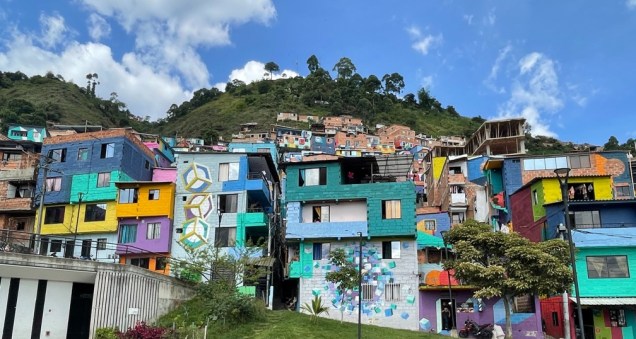
Collectively known as the Macromural, this open-air gallery decorates over 500 houses and many of the paintings feature the residents themselves or their hobbies and businesses. Started in 2003, it aimed (and has succeeded) to use art as a tool for urban transformation, promoting social consciousness and cultural expression, and bringing a sense of pride to the community.
Day three: Sustainable farming
 Medellín is called the “City of Eternal Spring” because it has a year-round mild climate that is great for agriculture. We got to experience this abundance again as we were bussed south to visit a family-run coffee farm in Envigado. Observatorio Agroecologico El Cafetal is Rainforest Alliance Certified, meaning it meets the organization’s environmental, social, and economic standards.
This was not a stereotypical farm with organized rows of plants, but rather a place where the coffee trees grow (seemingly wild) in a jungle of companion plants, birds, bees, and wildlife. The proprietors, Leticia and Alejandro, gave us a tour, explained their ethos as more holistic than just organic, described their production process, showed us their nursery, and let us sample their fine coffee…which, of course, we all bought to take home with us.
From there, it was a quick drive to Mandalaire, their neighbor’s farm-to-table restaurant. Owned and operated by Doña Marta, a farmer and an artist, this was another example of eco-friendly agriculture in harmony with the earth. We wandered around marveling at everything (sheep, flowers, mosaics, art) and then sat down for a delightful lunch cooked by Marta, herself, with ingredients fresh from her organic garden.


On to Cartagena
Day four: Getting there
 Next was a travel day with a short flight to the Caribbean coast, a short ride to the lovely Ameria Real Hotel, and some settling in. Hard to believe that this building originally served as the Royal Armory during Cartagena’s colonial era.
Although the neighborhood is quite festive now, the walled city with its canon-laden San Felipe de Barajas Fort reflects its battle-heavy history. A lot went on here! We took a short walking tour on our way to dinner at an Afro-Caribbean restaurant and came across a delightful wedding caminata, an Afro-Caribbean traditional parade of dancers and drummers.


Day five: Cooking like a local
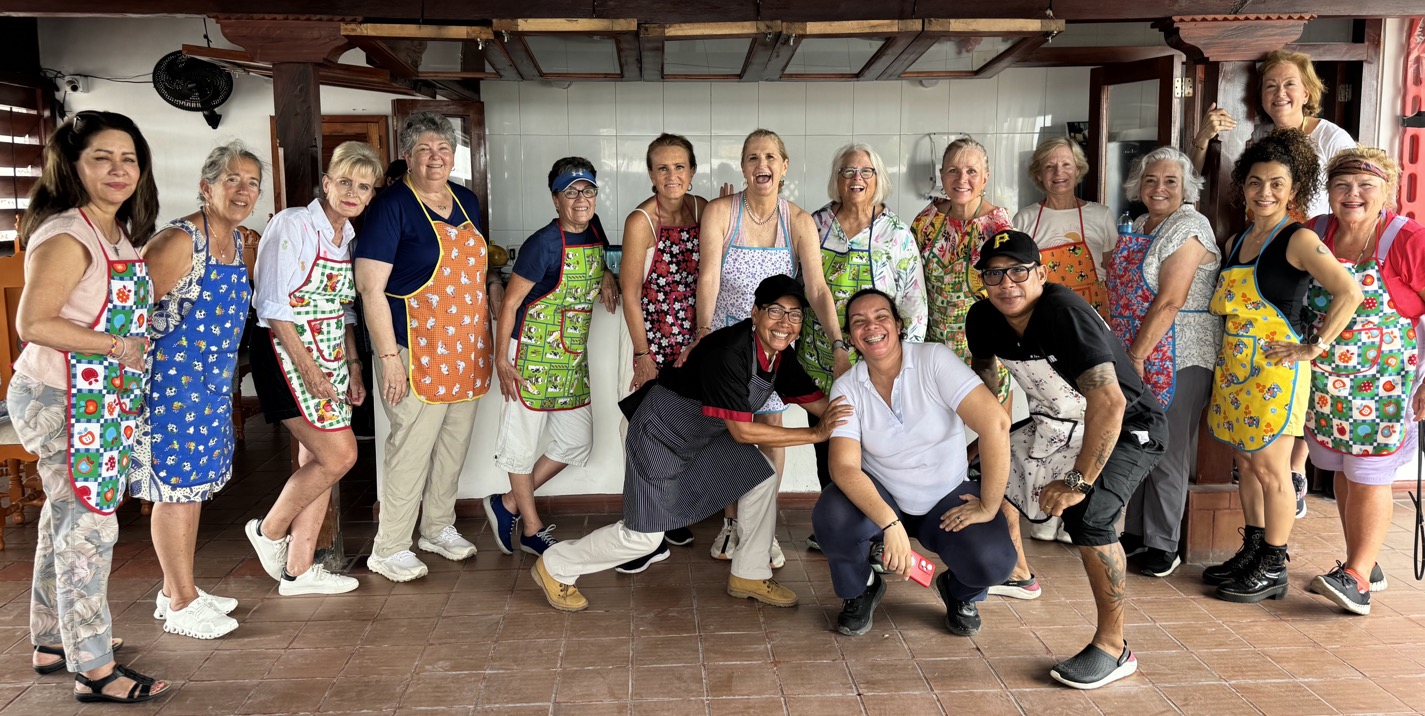
Caribbean cuisine is an important part of the Cartagena culture. Our group signed up for a session to learn how to make some typical dishes. But, before we could cook like a local we had to shop like a local! That meant a tour of Bazurto market, a true maze of delights—sights, sounds, smells—that ranged from stalls selling all kinds of fruits, vegetables, fish, and meat to places where you could get all this wonderfulness freshly cooked to eat in or take out. The walk to the market itself, led by our local guide Sondra, was colorful and educational. Chef Gloria and her son Juan chose what we needed while we took in the scene.
The cooking class was held in a large rooftop space with a professional kitchen and an adjacent covered dining area. We were quickly divided into (highly supervised) teams of 2-3 women, given specific tasks, and collectively turned out a delicious lunch of fish, coconut rice, fried plantains, and freshly squeezed lula juice. (They trusted me with a sharp knife!)


Day six: trip to IslaBela
A day at the beach was a welcome change of pace. The boat ride over to this private paradise was rollicking, but the water in the cove was calm and warm, and the large, comfy beach chairs were in the shade. In addition to swimming, there were options to go snorkeling, fishing, or get a relaxing massage before an al fresco lunch.


Day seven: Women entrepreneurs
Our next outing was to visit a women-led association in La Boquilla that helps mothers and grandmothers through tourism and handicrafts. Damartes (Ladies and Mothers of Art) was started in 2008 by seven women who took a craft class together and has since evolved to a thriving organization that produces jewelry, vases, containers, belts and accessories from coconuts shells being discarded by the neighborhood restaurants. After hearing their inspiring story, we sat down with them to make our own coconut souvenirs.


They are proudly the first women in La Boquilla to generate their own income!
Why I loved this trip
Colombia is awash with vivid colors, lively music, and happy people. As usual, our hotels were comfortable, almost all meals were included, and the restaurants were excellent, especially Celele where we had our farewell dinner. (I could write another blog just about all the Instagram-worthy food we ate!) Our activities were engaging with a focus on social projects that showed how communities can work together to better their world. The organizations created and run by women, for women, truly warmed my feminist heart. 
And, like all NextTribe trips, the sense of friendship that develops within the group was strong, bordering on sisterhood. I returned home with 13 new friends and felt like I got a true sense of modern Colombia, its people, and its challenges.
 accidental goddess
Thank you, Mary Lou!
This is a great!
LikeLiked by 1 person
Another wonderful blog!
Many thanks 👍
Susan
>
LikeLiked by 1 person
Really enjoyed this post. It seems there are organizations in Colombia which are truly trying to change the reputation of parts of Colombia. Mainly the women, of course. Please keep sharing your adventures with us!
LikeLiked by 1 person
Glad you liked it. I was very impressed by the work these people are doing after so many years of horror.
Miss you ❤
LikeLike
Think of you so often. Hope all is well in your world.
LikeLike
Yes. Let’s talk soon.
LikeLiked by 1 person
You pick great trips! Thanks for the play-by-play and for the extra words about how safe you felt in the country.
LikeLiked by 1 person