Why Morocco?
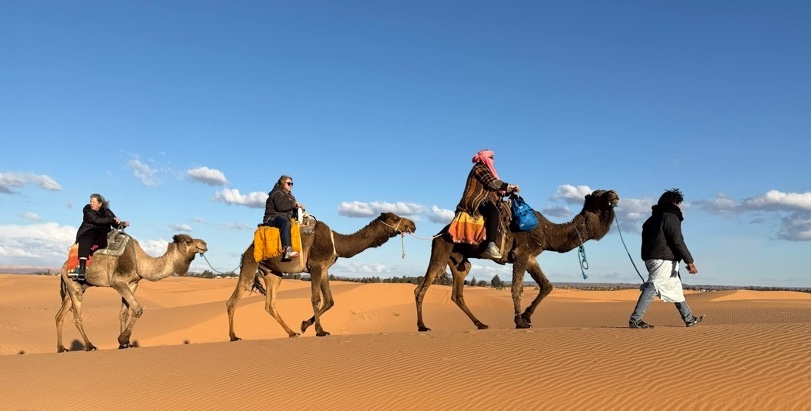
My father was an aircraft mechanic who often flew to Morocco in the 1950s to repair downed aircraft, probably at the Port Lyautey Naval Air Station near Casablanca. He sent us postcards of exotic-looking people leading camels through the desert and brought home cherished gifts of tooled leather and decorative brass. I was delighted to finally visit with NextTribe and learn more about this place of my childhood fantasies.
Overall
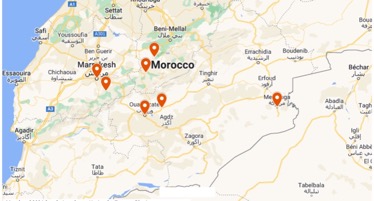 While this NextTribe trip seemed to cover a lot of ground on the map, it was just a small area of the country. We stayed in five different locations, starting and ending in Marrakesh, traveling on paved highways and rugged roads through the Ait Bouguemez Valley to the Atlas Mountains and into the Sahara Desert and back. We had a small van, but then switched to 4x4s, and eventually camels! Some of the trip was all the good things I had come to expect and the rest was a delightful surprise.
What I knew was that 1) I would be traveling with a group of intelligent, dynamic, fun-loving women; 2) we would go beyond the touristy stuff to connect, engage with, and support the local communities, especially the women; and 3) we would be in good hands.
 Our sweet, patient, and very smart guide M’Hamed was a Berber with nomad heritage. He spoke several languages (Arabic, Berber, French, English, Spanish, maybe more) and shared a wide range of information about Moroccan history and culture. He, and our van driver Lassen, took very good care of us. Their connections to the local communities were invaluable.
What I didn’t realize was that some of our accommodations (and the places we ate) would be open to the elements. Unlike most US hotels, traditional Moroccan riads and kasbahs have an enclosed courtyard without a roof. The rooms are on balconies that face inward. From there you can look down to the colorful mosaics, plants, and fountains in the center…or up to the sky. While I am sure these are glorious in warm weather, in January it was chilly. We were forewarned, so you’ll see us all bundled up in these photos.


In and around Marrakesh
We stayed at Riad Dar Nejma in the historic district and, of course, immediately went into the medina. Navigating the crowds and maze of souks with their vivid displays of textiles, spices, and crafts was both exciting and challenging. A fun pottery class and a day trip to the artist André Heller’s Anima Gardens, with its myriad of plants and sculptures, also fell into the “expected” category.
The unexpected parts were an impromptu stop at a roadside flea market, a visit to a factory where they process argan oil the old-fashioned way, and the local wildlife who were too eager to “commune” with us at the scenic Ouzoud Waterfalls.


And, after that, everything I experienced was eye-opening.
Through the Ait Bouguemez Valley
Nicknamed the “Happy Valley”, everything about this area of authentic Berber culture in the High Atlas Mountains was a revelation—from the ancient dinosaur prints to the way these people live simply and cooperatively with few modern conveniences. They build their houses of rammed earth and brush, grow their own food, herd sheep and goats, and use donkeys and mules for transportation. They taught us how to make tagines in an outdoor cooking class, and then gave us a tour of a typical Berber home, welcoming us with warm bread and tea.
We visited a women’s co-op where they proudly showed us how they weave rugs and tapestries from their animals’ wool using the most basic tools. On our last night, at the family-owned AdaZen Ecolodge where we stayed, the women decorated our hands with henna and our hosts regaled us with their music. Bonus: The lodge had a yoga room and we got together one morning for a quick class.


On toward the desert
We continued through the M’Goun Valley (Valley of Roses) to Skoura, stopping (and shopping) at another women’s co-op where they process Damascus rose petals to make cosmetics. You could see why this area, filled with palms and considered an oasis, was a stopover for early camel caravans. We stayed in the charming Kasbah Ait Ben Damiette and learned that a kasbah was a citadel or fortress surrounding and protecting the village or ksar. Some kasbahs, like ours, have been turned into hotels, others have been restored as national treasures. We got to wander through the warrens of an ancient ksar that, surprisingly, still houses 400 families.


Deep into the dunes
The van could only go so far into the desert, so we parked it and took 4x4s to an area in Merzouga, where we got on camels. We were led by young men for a one-hour ride over the dunes to Madu Luxury Camp in Erg Chebbi. This was an entertaining cross between a pony ride at the state fair and a “Lawrence of Arabia” fantasy come true. We stayed in tents that had electricity, heat, toilets, and showers. And, we were in the middle of the Sahara Desert! With delicious food, music around the camp fire, and a night sky filled with stars…what’s not to love?


Yes, there were nomads!
The next day, back in the 4x4s, we visited a nomad family with three little children who live in tents that are nothing like the tents we were staying in. These people move across the desert to find grazing areas and water sources. They herd livestock and rely on their animals’ milk, meat, and wool for sustenance and trade. For me, the iconic moment of this whole trip was when they graciously served us hot baked bread and tea in their “dining room” tent. Back in my privileged suburban comfort, I am still trying to process this.
Circling back
Our next stop was Village Khamlia in the town of Merzuga, where slaves from the sub-Saharan settled. At Restaurant Café Nora, we had a lesson in making Medfouna (nicknamed Berber pizza) from rounds of dough that we stuffed with meat, vegetables, and spices. While our food was cooking, we were entertained with a Gnaoua music performance, and then feasted on our creations.


On our journey back to Marrakech, we stopped at a large lake; a lush oasis with cooperative gardens and hand-built aqueducts; and the “Labyrinthe du Sud”, the biggest, most elaborate shop with more authentic rugs, artifacts, and jewelry than I’ve ever seen. Every one of these was a new and wonderful experience.


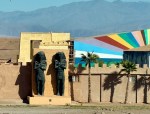 Our last stop was in Ouarzazate for a quick look at Atlas Film Studio, the “Hollywood of Africa”, where many famous movies were made. It is also home to Kasbah Taourirt and the UNESCO World Heritage site Ait Ben-Haddou
Sweet, sad ending
Our last day in Marrakesh gave us an opportunity to do our own thing: indulge in a restorative hammam, visit the Jardin Majorelle, or continue to shop. There were toasts and tears (and a belly dancer) at our last dinner together. Many of us claimed this was their best NextTribe trip ever!
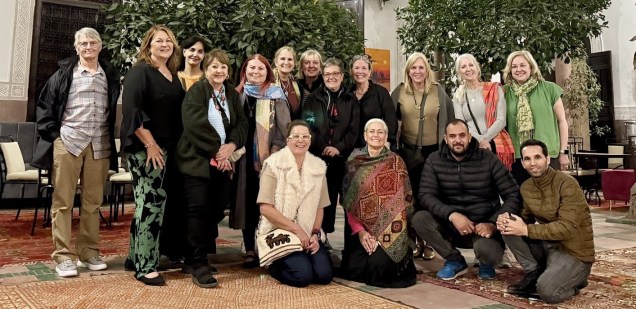
Shout out: Many of the best photos in this blog were taken by my travel companions and I thank them immensely for sharing their craft with me and our group.
Fun Facts
 Our most frequent dinner was a tagine of vegetables, with chicken or beef (for the meat-eaters) and sometimes with couscous. Tagines are slow-cooked and served in an earthenware pot with a cone-shaped top. It’s the Moroccan equivalent to a crock pot.
 Oranges were everywhere: growing on trees, stacked on plates on our tables, served sliced with our meals, piled high on carts at the flea market, in the souk, and on the side of the streets. Fresh, delicious, and always with their leaves intact.
 Every place we stopped—hotel, restaurant, local shop, cooperative, or nomad camp—we were served tea on a tray of small glasses. It was always poured ceremoniously in a stream from a fancy teapot held high above the glasses. This is our host serving us tea in the courtyard of a Berber home.
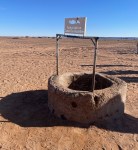 Individual water wells—some with solar panels to run the pumps—were seen around the desert. And, there were different types of aqueducts near the oases. Surprisingly, the water table in the Moroccan Sahara is shallow because a layer of rock prevents water from seeping deep into the ground.
 An erg, like Erg Chebbi where we camped, is a large area of sand dunes formed by wind. The dunes come in six shapes: transverse, oblique, longitudinal, barchan, star, and parabolic. This one is a star formation.
 Formal U.S. relations with Morocco date from 1787, when the two nations negotiated a Treaty of Peace and Friendship, the longest unbroken treaty relationship in U.S. history.


Thank you, Mary Lou for this amazing commentary and pictures of your trip to Morocco. You experienced a culture that not many people get to know and through your detailed and entertaining descriptions, I enjoyed learning a little about this exotic place.
LikeLike
Everything Lydia said. The record of your trip is enlightening in so many ways.
Really grateful for the effective way you put it all together.
LikeLike
You pick really interesting places to travel. Thanks for sharing what travel with NextTribe is like for you.
LikeLike